ANGOLA
Legal framework on freedom of religion and actual application
The Constitution of Angola upholds the principle of separation between Church and State. Article 10 (2) affirms: “The State shall recognise and respect the different religious faiths, which shall be free to organise and exercise their activities, provided that they abide by the Constitution and the laws of the Republic of Angola.”[1]
According to Article 236 (g), if the constitution is subjected to changes, these must respect “the secular nature of the state and the principle of the separation of church and state”.[2] The constitution also prescribes that the State shall protect “churches and faiths and their places and objects of worship, provided that they do not threaten the Constitution and public order” (Article 10, 3). Meanwhile, Article 41 provides for freedom of conscience, religion, and worship and recognises the right to conscientious objection.
According to Law 12/19 of 14 May 2019, concerning Freedom of Religion and Worship, which repeals Law 2/04 of 21 May 2004 on the Exercise of Freedom of Conscience, Worship, and Religion, there are specific requirements for the recognition of foreign religious groups in Angola. These groups must submit a formal request for recognition, accompanied by authenticated copies of their statutes and founding documents, either written in or translated into Portuguese. They must also provide a declaration of legitimacy issued by the public authority responsible for religious affairs in their country of origin.
Furthermore, a minimum of 60,000 signatures is required for a group to be recognised, including at least 1,000 Angolan citizens or foreign residents over the age of 18 who are in full possession of their civil rights from each province of Angola. Additional documents required include valid passports and proof of residence for foreign citizens, a criminal record check certified by Angola’s consular service in the applicant’s country of origin, and a declaration of assets and income for religious ministers, verified by official documents. The application must also include a proposed construction plan for a place of worship. Public authorities retain the right to request supplementary documents and information, including details about the doctrine and worship practices adopted by the denomination.[3]
The National Institute for Religious Affairs (INAR), a public sector entity with administrative and financial autonomy under the Ministry of Culture and Tourism, is responsible for designing and implementing the State’s policy on freedom of religion, conscience, and worship.[4]
Only registered groups are officially entitled to their own schools and places of worship, although this law has not always been enforced. Religious instruction in Angola is not a component of the public educational system, however, private schools are allowed to teach religion.[5] The government observes Good Friday, Easter Sunday, and Christmas Day as religious holidays. Only Christian festivities are recognised as public holidays.[6]
Angola has been a party to the International Covenant on Civil and Political Rights since 1992.[7]
Incidents and developments
The Islamic community in Angola has expressed frustration over the government’s apparent lack of will to officially recognise Islam, despite multiple attempts to meet the requirements set by authorities.
In September 2023, Altino da Conceição, leader of the Islamic Council (CIM) of Angola, estimated that around 100,000 people practise Islam in the country, although it remains unrecognised due to what he described as a “lack of political will”. He explained that Muslims first requested official recognition on 8 August 1978, without success, and only in 2018 were they added to the list of religious groups awaiting recognition. Despite this, according to the sheik, “every day many Angolan and foreign citizens have been converting and entering ‘voluntarily’ into the Islamic religion”.[8] Mosques are present across Angola, except in the Bié province, and number nearly 200. While expressing frustration over the lack of progress, Altino acknowledged improvements in religious freedom, noting that mosque closures, common in the past, are no longer occurring.
Back in August 2021, the Director of the National Institute for Religious Affairs (INAR), Francisco de Castro Maria, explained that official recognition of Islam depended on the unification of the different factions within the Muslim community in Angola. He emphasised that as long as these internal divisions persisted, the government could not proceed with legalisation.[9] Speaking at the Ebad Al Rahman mosque in November 2023, the President of the Islamic Council of Mozambique, Sheikh Aminuddin Muhammad, said that despite the lack of formal recognition, the authorities were in practice acting as if it had been granted.[10] Still, the visiting Muslim leader stressed that the absence of formal recognition of Islam in Angola hindered the development of social activities by Muslims.[11]
In May 2023, Parliament passed a law to regulate the activities of non-governmental organisations (NGOs). According to some experts, including three UN rapporteurs, the legislation imposed undue restrictions on NGO freedom.[12]
In August 2023, the first native Angolan, Archbishop Germano Penemote, was appointed Apostolic Nuncio, an event celebrated by Catholics in the country as a milestone in the history of the Angolan Church.[13]
In November 2023, the White House released a factsheet about the relationship of the United States with Angola and its commitment to aiding the country with its economic and security issues. This statement also mentioned the United States’ firm resolution to continue supporting the Angolan government in its efforts to protect, among other things, the rights of its citizens to freedom of religion or belief.[14]
In March 2024, the government recognised the new Church of the Kingdom of God in Angola (IRDA), which replaces the Universal Church of the Kingdom of God (IURD), and the transfer of assets from the old entity to the new. Since 2019, the Universal Church of the Kingdom of God (IURD) in Angola had faced a significant internal crisis, leading to a split between Angolan and Brazilian leaders. Angolan leaders accused the Brazilian leadership of practices such as racial discrimination and imposing vasectomies on local pastors. In response, Angolan bishops and pastors took control of Church buildings, severing ties with the Brazilian leadership. The Angolan government intervened, officially removing the Brazilian leaders and recognising the new Angolan leadership. Subsequently, the Angolan faction began operating under the name “Church of the Kingdom of God in Angola,” while the Brazilian faction retained the original name, IURD.[15]
In July 2024, the President of Angola, João Lourenço, met with the head of the Catholic Bishops’ Conference of Angola and São Tomé (CEAST), Archbishop José Manuel Imbamba, to discuss religion’s place in social life, including the family. In an interview after the meeting, the archbishop stated that he and the president had “examined religious issues that threaten social peace and attack the integrity of Angolan families within the context of the (2019) Framework Agreement that regulates relations between the Holy See and Angola”.[16] The prelate also underscored the need for “social, political, spiritual, economic and legal transformation in the country, so that Angola, as it celebrates its 50th anniversary, is reborn with inclusion, meritocracy, and fraternity”.[17]
In a September 2024 interview with Fides News Agency, Bishop Martín Lasarte Topolansky of the Diocese of Lwena highlighted Angolan challenges distinct from those discussed in Western contexts. He emphasised that low educational levels, lack of services, leprosy, and the spread of aggressive sects were pressing concerns for the Catholic community in Angola. The bishop noted that while secularisation was a significant issue in Europe, the Angolan Church faced challenges around first evangelisation, lay formation, interreligious dialogue, and the rapid growth of various sects. He expressed concern over the rise of Islamist influences, mentioning instances where Christian women marry Muslim men, leading to their children studying in predominantly Islamic countries and returning with extremist views. Additionally, he pointed out the proliferation of neo-Pentecostal sects that operated independently, often without dialogue even with local Protestant Churches. The persistence of magic and witchcraft also contributed to violence and killings in certain areas, he said, further complicating the pastoral mission of the Church.[18]
Prospects for freedom of religion
Religious freedom in Angola is generally guaranteed. However, during the period under review, certain challenges have been observed, including criticisms from the Islamic community regarding the lack of recognition of their religion, the spread of various sects, and the potential development of radical Islamism. The prospects for religious freedom remain unchanged, but the situation requires close monitoring.
Sources


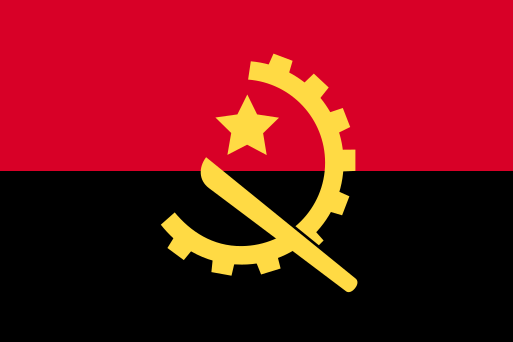 Angola