Legal framework on freedom of religion and actual application
In July 2023, the Central African Republic (CAR) held a constitutional referendum that led to the adoption of a new constitution, replacing the 2016 charter. The revised text abolished the two-term limit for the presidency, extended the presidential term from five to seven years, established the role of Vice President and dissolved the Senate in favour of a Council of Traditional Authorities. The new constitution was officially promulgated on 30 August 2023. While the government claimed that over 95 percent voted in favour with a turnout of 57 percent, opposition parties and civil society organisations denounced the process as a sham and reported real turnout closer to 10–13 percent. The new constitution paves the way for President Faustin-Archange Touadéra to seek a third term when elections are held on 28 December 2025.[1]
In the preamble of the new constitution[2] the people of the Central African Republic are described as “aware that tolerance, inclusion, consultation and dialogue are the foundation of peace and national unity” as well as being conscious of their “ethnic, cultural and religious diversity” and “wanting to build a united, supportive and prosperous nation”. Article 7 prohibits political parties from identifying with any specific ethnicity, religion, gender, language, region or armed group. Article 13 guarantees non-discrimination — including on religious grounds — in accessing education and public office. Article 22 affirms the right to freedom of thought, conscience, and religion, specifying that the conditions for exercising this right shall be determined by law.[3]
All religious denominations have the right to broadcast a weekly program on state radio (Radio Centrafrique) and to operate their own radio stations. Bangui-based Radio Notre Dame, which is Catholic, and Radio Voix de l’Évangile (known previously as Radio Nehemie), which is Protestant, are the main confessional radio stations. Some other Catholic stations broadcast freely. Radio Siriri, in Bouar, and Radio Maria, in Bossangoa (also broadcasting in Bangui since the end of 2013), have a large following.
The CAR signed a framework agreement with the Holy See on 6 September 2016,[4] which entered into force on 5 March 2019.[5] It established a juridical framework for the relations between Church and State in which both entities, safeguarding their autonomy, committed themselves to cooperating for the common good as well as the moral, social, cultural and material well-being of all citizens.
The difficulties faced by foreign missionaries in obtaining legal residence in the CAR remain a longstanding concern. At the January 2020 plenary of the Central African Catholic Bishops’ Conference (Conférence Episcopale Centrafricaine, CECA), bishops raised the issue with the Ministry of Foreign Affairs, citing persistent delays and prohibitive fees that hinder the deployment of non-CAR religious personnel.[6] The situation is likely to worsen following the updated visa policy of 12 February 2024, which requires all foreign workers — including missionaries — to secure prior authorisation from the Ministry of Foreign Affairs in Bangui before applying for a visa at a CAR embassy, adding a further bureaucratic hurdle to an already complex process.[7]
Religious groups, other than those who hold indigenous religious beliefs, are required to register with the Ministry of the Interior and Public Security. To engage in this procedure, they must prove that they have a minimum of 1,000 members and that their leaders have adequate religious training, as evaluated by the ministry.
According to the law, registration can be denied to any religious group if it is offensive to public morals and public health or is responsible for disturbing the peace. The procedure is free and confers official recognition and certain benefits, such as customs duty exemptions for vehicles or equipment. There are no penalties for groups that fail to register.[8]
The latest religious denomination to register was the Russian Orthodox Church, officially approved by the Ministry of Territorial Administration on 4 July 2022. Around this time, the Russian Orthodox Church established a church in Bangui’s city centre. For many observers, this is part of the growing Russian influence in the country, which has been increasing since 2017.[9]
New religious groups, particularly Pentecostal Churches, have been growing in the CAR over the last few years, holding religious services without any difficulties.[10]
Muslim representatives from COMUC (Coordination de la Communauté des Musulmans de Centrafrique) reported that Muslim citizens continue to suffer arbitrary detention, extortion and extrajudicial killings by government forces, who accuse them of belonging to or helping armed groups. COMUC also noted that Muslims face significant obstacles in obtaining national identity documents, essential for accessing public services. They criticised the stricter nationality requirements introduced by the new constitution, arguing that these disproportionately affect Muslims, who often lack the required documentation. Community leaders also denounced widespread corruption, noting that Muslim applicants are frequently charged up to five times more than non-Muslims and are asked to provide additional proof of citizenship and residency.[11] This limits access to public services and reinforces marginalisation.[12]
Religious education is not compulsory but is available in most schools. The Catholic Church operates a nationwide school network across all nine dioceses, coordinated by the Associated Central African Catholic Schools (Écoles Catholiques Associées en Centrafrique, ÉCAC), under a memorandum of understanding with the Ministry of Education. Despite this formal partnership, ÉCAC has denounced the government’s chronic neglect — particularly the failure to pay teachers’ social security contributions for over 25 years — forcing the schools to rely on the private sector and religious organisations amid rising costs.[13] The state-run University of Bangui has a Catholic chaplaincy next to its campus, operated by the Jesuits, with a wide range of pastoral and cultural activities.[14]
The main Christian festivities are public holidays: Good Friday, Easter, Ascension, the Assumption of Our Lady, All Saints and Christmas. The State also recognises the Muslim festivities of Eid al-Fitr and Eid al-Kebir as public holidays. Over the last few years, it has become customary for high-ranking government officials (almost all Christians) to attend public prayers in mosques in Bangui and the country’s various prefectures during these two main Muslim feasts.
Despite prior government assurances, the long-overdue local elections, initially set for 25 October 2024 but postponed to April 2025, failed to take place and were postponed again.[15] When they eventually happen, they will be the first such elections since 1988. Civil society views them as crucial for strengthening democracy.[16]
Incidents and developments
The Central African Republic remained one of the poorest countries in the world, ranking 191 out of 193 on the Human Development Index in 2023. It was also one of the most dangerous countries for humanitarian workers, with 145 incidents in 2024, and a 30 percent increase in fatalities over the previous year.[17] Among the countries of Central Africa, it was ranked in 2023 as the least politically stable, and the one most affected by terrorism.[18] One of the rare positive developments over the reporting period was a reduction in the number of displaced people. Many who had left their homes because of the civil war were able to return, and in July 2025 OCHA reported that only around seven percent of the population was still displaced.[19]
Between 2023 and late 2024, President Faustin-Archange Touadéra further consolidated his authority through a controversial constitutional referendum held in July 2023, for which he hired extra Russian mercenaries as security. As well as supporting him against rebels, the mercenaries have been reportedly trading in minerals and timber.[20]
The revised constitution abolished presidential term limits, extended the presidential mandate from five to seven years, created the post of vice-president, and replaced the Senate with a Council of Traditional Authorities. While the government claimed over 95 percent approval with around 60 percent turnout, opposition parties and independent observers reported widespread irregularities and argue that turnout was as low as 10 percent.[21]
During the same period, civil liberties came under increasing pressure. Civil society groups and independent media outlets faced harassment and repression, narrowing an already fragile democratic space.
Between January 2023 and December 2024, multiple sources documented numerous violations of religious freedom in the Central African Republic (CAR).[22] Armed groups, often organized along religious lines, persisted in targeting civilians, deepening communal divisions and fueling cycles of retaliation. Reports from MINUSCA, the UN peacekeeping mission, detailed arbitrary arrests, torture, and killings of Muslim civilians by government forces and Wagner Group operatives, especially in the regions of Nana-Grebizi, Ouandago, and Bangui.[23] Despite these abuses, the justice system remains notably weak in prosecuting religiously motivated crimes, allowing impunity to flourish and undermining efforts to protect vulnerable communities.[24]
Security across the Central African Republic remained unstable, with persistent fighting between government forces — supported by Russian mercenaries — and armed groups, particularly the Coalition of Patriots for Change (CPC), which was formed from both Christian and Muslim militias.[25] Russian operatives, originally part of the Wagner Group, were instrumental in securing some towns but were also accused of serious human rights violations.[26] In May 2023, CBS released a report[27] about a 2021 massacre by the Russians in the mostly Muslim gold mining town of Bambari. Eyewitnesses described executions, torture, and rape carried out by Wagner mercenaries. “They were shooting us from the ground and from the sky,” said one witness. Another said that “killing” was an understatement. “It was total carnage. Like Armageddon.” A United Nations report added that both government troops and Russian mercenaries shot civilians at the Bambari mosque “without respect for the religious nature of the building”.[28]
On 10 February 2023, a landmine explosion severely injured Father Norberto Pozzi. A Discalced Carmelite missionary, Father Pozzi lost a foot when his vehicle struck a landmine on the road between Bozoum and Bouar; the other passengers sustained less serious injuries. The incident has heightened concerns among Church leaders regarding the safety of clergy and the faithful in regions affected by landmines and rebel activity. In response, the Church has called for more robust institutional measures to ensure secure passage, particularly in areas where humanitarian and pastoral work is actively carried out.[29]
On 5 May 2023, Muslim shopkeepers in Bangui’s PK5 district staged a ville morte strike after Russian mercenaries detained and repeatedly tortured an imam and his cousin.[30]
Catholic bishops in the Central African Republic (CAR) questioned the government's decision to hold a constitutional referendum, citing ongoing insecurity, political instability, and social unrest. In a June 2023 statement, the Central African Episcopal Conference (CECA) criticised the referendum as poorly timed given the nation’s deep socio-political and economic challenges. The bishops condemned calls for violent resistance from some political figures and highlighted the long-term impact of repeated crises, which they say have eroded family structures, disrupted education, and fostered a culture of violence and impunity. Urging greater cooperation between the Church and State, they emphasised the need to promote peace and national unity.[31]
Despite continuing reports of abuses by rebels, a 2023 study by the United Nations peacekeeping force MINUSCA showed that state actors, including the army and police, were responsible for 57 percent of human rights violations and 90 percent of cases of torture.[32] MINUSCA also reported increased discrimination against Fulani and Muslim communities, especially in accessing national ID documents. In Berbérati, police reportedly demanded inflated fees and excessive documentation from Muslims seeking ID cards.[33]
A key point of interreligious tension is the overcrowding of cemeteries in Bangui. The use of a Muslim cemetery by the Christian community has made it increasingly difficult to maintain harmony between the groups. As some young residents use the site for social gatherings and drinking to ease tensions, there are concerns about the potential for future conflicts. The State’s response has been slow, contributing to the ongoing challenges.[34]
In August 2024, at the request of their families, the government exhumed approximately 100 bodies of Muslims buried in a cemetery attached to an Evangelical church in the 3rd district of Bangui for transfer to a Muslim cemetery in the commune of Bimbo 3. Muslim community representatives view it as a demonstration of the government’s commitment to peaceful coexistence, and civilians believe it will begin to restore goodwill between the two faiths.[35]
While religious identity has often been a fault line, it has also served as a force for resilience and reconciliation. In the absence of effective political mediation, local religious leaders have played a vital role in de-escalating tensions and fostering intercommunal dialogue.[36] Building on this foundation, several initiatives have sought to institutionalise interfaith cooperation. In 2024, KAICIID (the International Dialogue Centre), in partnership with the University of Bangui and supported by the national interfaith body (PCRC), launched a pioneering interreligious dialogue module. The program trains future leaders in conflict resolution through interfaith principles, aiming to promote reconciliation and social cohesion through structured peacebuilding education.[37]
In a May 2024 statement, the Archbishop of Bangui, Cardinal Dieudonné Nzapalainga, denounced the concentration of wealth in the hands of a small elite, while most of the population remained in poverty. Despite improved security — evidenced by reopened schools and resumed commerce — the aftermath of conflict continues to hinder education and the rebuilding of infrastructure. The Cardinal also stressed the Church’s role as a prophetic voice, advocating for the marginalised and promoting social justice and fair resource distribution.[38]
Cardinal Nzapalainga was among three Central African religious leaders honoured with the Aegis Trust Award in Kigali, Rwanda, in July 2024. Founded in 2002, the Aegis Award celebrates religious figures who actively resist sectarian violence and promote interfaith harmony. The award was jointly given to Cardinal Nzapalainga, Apostle Nicolas Guérékoyame-Gbangou, President of CAR’s Evangelical Alliance, and the late Imam Omar Kobine Layama, former President of the Islamic Council. At the height of the conflict, Cardinal Nzapalainga sheltered Imam Layama and his family in his Bangui residence, exemplifying interreligious solidarity. Together, the three leaders founded the Platform of Religions in CAR, taking personal risks to visit violence-ridden areas in a bid to restore peace.[39]
Russian mercenaries continued to cause mayhem throughout the reporting period. In April 2024, around the village of Yemen in the east of the country, helicopters and a ground assault were used in a botched attempt to capture Joseph Kony,[40] leader of the Lord’s Resistance Army (LRA) insurgent group. The extremist militia has been responsible for over 100,000 deaths and 60,000 abductions of children in Uganda, DRC and the Central African Republic.[41] The Russian mercenaries burned down several villages in the area and killed civilians, sustaining casualties in a gunfight with the LRA whose members then vanished into the bush. Joseph Kony himself, as always, eluded the mercenaries, disappearing in the direction of Sudan well before the surprise attack took place.[42]
In July 2024, clashes between the rebel group 3R (Return, Reclamation, Rehabilitation) and the army displaced 10,000 civilians. The rebels struck nearly 10 villages between Bocaranga and Bazoum near the Cameroon border. Formed in 2015, 3R claims to defend Muslim cattle herders from Christian anti-Balaka militias but is accused of widespread atrocities, including killings, rapes and forced displacements. The extremist group has also engaged in kidnappings, targeting both UN peacekeepers and local civilians. The militia, with hundreds of fighters, operates along the CAR-Cameroon border, retreating into eastern Cameroon when pursued.[43] Beyond its military operations, the group maintains control over illicit economies, including cattle taxation, gold trading, and arms trafficking, particularly in western parts of the country.[44]
On 26 November, while returning from a religious ceremony near the central diamond mining town of Bria, six motorcycle taxi drivers and four passengers were killed, ambushed by unidentified gunmen.[45] While the attack was not directly framed as religious persecution, it exemplifies how religious observance may elevate vulnerability amidst conflict. No one immediately claimed responsibility for the attack, but the mining town of Bria has been plagued by fighting between the country’s armed forces and the Coalition of Patriots for Change, an anti-government militant group, in recent years.[46]
In a January 2025 interview with Vatican News, Bishop Désiré Nongo Aziagbia of Bossangoa, President of the Central African Episcopal Conference, reflected on the 130th anniversary of evangelisation in the country, marked in 2024. The bishops expressed deep gratitude for the early missionaries who translated the Bible into local languages, trained catechists, built churches, and promoted education and vocational training in areas such as agriculture, mechanics and healthcare. Bishop Nongo also drew attention to the persistent hardships facing Christians in the Central African Republic, including nearly a decade of protracted crisis, pockets of insecurity, and severe challenges in development, healthcare, education and essential services.[47]
Prospects for freedom of religion
Despite constitutional guarantees and symbolic gestures of interfaith solidarity, religious freedom in the Central African Republic remains precarious. More than a decade of civil conflict — fuelled by clashes between anti-Balaka and predominantly Muslim Séléka militias — has deeply fractured trust between Christian and Muslim communities. Systematic institutional discrimination — especially against Muslim communities — persists, fuelled by bureaucratic hurdles, corruption and the politicisation of identity documents. Local religious leaders continue to play a crucial role in dialogue and conflict prevention, but their efforts are hindered by deep-rooted insecurity, political repression and fragile institutions. With key elections approaching at the end of 2025, their role in fostering social cohesion will be increasingly vital. The prospects remain negative.

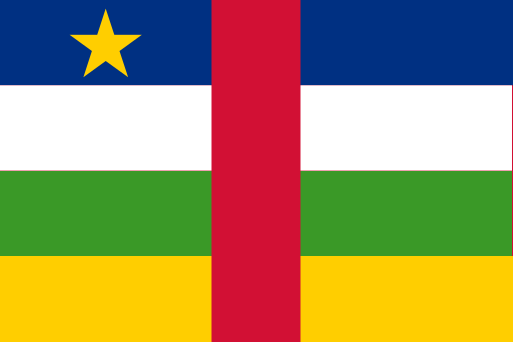 CAR
CAR