Legal framework on freedom of religion and actual application
Article 15 of the Cuban constitution, promulgated on 10 April 2019, states that “The State recognizes, respects, and guarantees religious liberty,” while at the same time defining the country as a secular state.[1] It further provides that “religious institutions and fraternal associations are separate from the State and share the same rights and duties,” and that “distinct beliefs and religions enjoy equal consideration.”
Article 42 affirms that, “All people are equal before the law, receive the same protection and treatment from the authorities, and enjoy the same rights, liberties, and opportunities, without any discrimination for reasons of [...] religious belief”. Any violation will be “sanctioned by law.”
Article 57 recognises the right of every person “to profess or not profess their religious beliefs, to change them, and to practice the religion of their choice with the required respect for other beliefs and in accordance with the law.”[2] However, the Preamble to the Constitution declares that it is “only in socialism and communism that a human being can achieve his or her full dignity,” while Article 5 presents the Communist Party of Cuba (CPC) as “the superior driving political force of the society and the State,” describing it as “unique” and “Marxist-Leninist,” inspired by José Martí and Fidel Castro, and adding that it alone “organises and guides the common effort in the edification of socialism and progress toward a communist society.”[3] In effect, the CPC bases Cuban socialism on Marxism-Leninism, thereby subordinating individual freedoms to the interests of the State and the preservation of the system.
The imposition of a single political and social model contradicts fundamental rights such as the freedom of thought, conscience and religion. In practice, many activities connected to the exercise of such freedoms, including religious freedom, remain subject to the will of the State, and there are no independent institutions capable of autonomously guaranteeing constitutional rights.
In its various historical expressions worldwide, the socialist paradigm has proven incompatible with individual rights as defined by Article 18 of the United Nations Universal Declaration of Human Rights, which guarantees “freedom of thought, conscience and religion [...] either alone or in community with others and in public or private, to manifest his religion or belief in teaching, practice, worship and observance.” [4]
According to the constitution, the CPC maintains total control over these areas through its Ideological Department, which oversees the Office of Religious Affairs (ORA). The head of the Ideological Department, Rogelio Polanco, was appointed Cuban ambassador to Vietnam and has not yet been replaced. This reflects a fundamental problem regarding religious practice in Cuba, which involves not only “the simple freedom to hold religious beliefs, but the freedom of each person to live according to their faith and to express it publicly”.[5]
The constitution does not provide for legal recognition of Churches, nor does it envisage the possibility of their “systematic access to media, freedom to teach and evangelise, to build infrastructure and to own the necessary items for its activities, or the right to association for non-exclusively religious ends, such as educational, cultural, health or charity”.[6]
Offences in the Criminal Code
The new Criminal Code of Cuba, adopted on 1 December 2022, subordinates religious practice to the political interests of the Communist Party and contains provisions that directly affect the exercise of this right.
Article 272 on “Abuse of religious freedom” restricts the educational freedom of parents, establishing penalties for “whosoever, abusing constitutionally guaranteed religious beliefs or practices, holds them in opposition to the purposes of education, […] or to any other duty established by the constitution.”[7] Penalties range from six months to one year of imprisonment, or fines of 100 to 300 penalty units, or both.
The Code also imposes severe limits on freedom of expression – a right which is closely linked to religious liberty – and imposes heavy penalties for criticism of the socialist state, with the use of social media listed as an aggravating factor. Article 124(1), in the chapter on “Crimes against the internal security of the State,” provides for prison terms of three to eight years for anyone who “incites against the social order, international solidarity or the Socialist State as recognised in the Constitution of the Republic.” If this incitement is carried out through social media, the penalty increases to four to 10 years.[8]
Article 266 on “public disorder” punishes the dissemination of fake news as well as “malicious predictions aimed at causing alarm, discontent or disinformation among the population” with imprisonment of one to three years. The penalty rises to two to five years if committed through “social media or means of social communication in both the physical and digital realm”.[9] To place in perspective, this is the same punishment applied to people who cause public disorder with firearms or explosives.
Article 270, in Chapter IV, punishes whosoever belittles “the institutions of the Republic of Cuba, and the country’s political organisations, be they of a mass or social nature,” with imprisonment of two to five years.
Legislation approved in 2024
Legislation approved in 2024 further expanded the power of the Cuban government and restricted citizens’ rights, with potential repercussions on religious freedom.
The Citizenship Law[10] allows the government to withdraw citizenship from anyone who commits “acts contrary” to the political interests of the country, without clearly defining what would constitute such an act or who determines it.
The Law on Immigration and Foreigners[11] also allows the authorities to deny entry into or restrict the exit of individuals for reasons of defence or national security, or if they have been found guilty of “acts hostile to the political, economic and social foundations of the Cuban State.”
Finally, a new Social Communication Law replaced the 1976 media law. Article 13(3a) prohibits the use of published content to “subvert the Constitutional order and destabilise the rule of law and social justice of the Socialist State,” or to defame, slander or offend the regime (Article 13(3,i)). Article 28(2) further provides that “news agencies, radio, television and print or digital means of social communication” are “the socialist property of the entire people or of the political, mass or social organisations and cannot be subject to any other form of ownership, in accordance with the Constitution”.[12]
The Associations Law
Article 274, Chapter VIII of the Criminal Code, “Illegal associations, gatherings and demonstrations,” states: “a non-authorised association incurs a punishment of deprivation of freedom for six months to a year”, with the penalty rising to six months to two years for organisers. Those responsible may also have their property confiscated. Article 275 punishes the organisation of, or participation in, gatherings held by such associations.[13]
This article is important because many newly established Evangelical Protestant Churches are neither registered nor authorised in Cuba. According to sources close to the government, 651 religious institutions and 1,562 fraternal institutions are enrolled in the Registry of Associations of the Republic of Cuba, half of which were registered and recognised following the revolution. Groups that remain legally unrecognised are described as potential sources of division.[14]
The transitional provisions of the 1985 Associations Law stipulated the creation of a “Law on the regulation of religious worship.”[15] In the absence of such a law, most religious institutions remain subject to the Law of Associations. The 2019 constitution removed the provision that “The law regulates the relations of the State with religious institutions,” thereby seemingly excluding a law on religious worship for the time being.[16]
According to the 2025 legislative program, to update various legal areas, a “Law on types of association” is expected to regulate matters related to worship and to define the responsibilities of the Department for Religious Institutions and Fraternal Associations.
The Catholic Church is not included in the Registry of Associations, except when applying for construction permits, which fall under the Ministry of Justice.
An association will be denied legal recognition if its activities duplicate those of a previously registered group. Once recognised, religious entities may obtain authorisation from the Office of Religious Affairs before carrying out their activities.[17]
There are three state-run associations: the Council of Churches, for Protestants, Pentecostals and Evangelicals; the Cultural Yoruba Association, for the Yoruba religion; and the Cuban Islamic League, for Muslims. Critics contend that these entities are controlled by the State, overriding the voices of their respective religious communities.[18]
There are also doubts about the political independence of the Interreligious Dialogue Platform, which claims to gather “believers of the seven established religions in Cuba, and fifteen associations and institutions, as well as people guided by faith in Cuba.”[19] The platform is run by Enrique Alemán Gutierrez, a member of the Cuban Parliament.[20]
Office of Religious Affairs
Cuba lacks a legal framework to protect religious freedom. The Central Committee of the Communist Party’s Office of Religious Affairs (ORA)[21] oversees different aspects of religious life: it approves or denies visits by foreigners to religious associations; authorises the construction, repair or acquisition of places of worship; grants permits for public religious services; and regulates the importing of religious literature.
In March 2022, the government created the Department for Religious Institutions and Fraternal Associations as “part of the strengthening of government structure.”[22] Since then, it has taken over procedures for religious entry into Cuba, the management of construction projects and the registration of property.[23] Nevertheless, the ORA has continued its task to “implement the policies of the Cuban Revolution among religions and believers”.[24]
In December 2024, government supervision of religious institutions and fraternal associations was included for the first time on the agenda of the Council of Ministers. The report highlighted the department’s mission to “assist the Prime Minister in conducting and executing administrative tasks related to the rules that implement approved policy regarding religious institutions and fraternal associations.”[25]
Resolutions 43 and 46 of February 2005, published in the Official Gazette (No. 8, April 2005), regulate and restrict the use of places of worship. Resolution 43 requires religious organisations to obtain prior government authorisation for repairs (even minor ones), extensions and new construction. Resolution 46 sets out the guidelines for the application, processing and authorisation of worship in private homes.[26]
Although dozens of religious confessions coexist in Cuba and freedom of worship is formally acknowledged, the right to religious freedom remains conditioned by and subordinate to the totalitarian control of the State and the Communist Party. This control limits, restricts and regulates a wide range of initiatives connected to religious practice.
Incidents and developments
Dozens of incidents were reported in 2023 and 2024. As in other autocratic states, most of these arose from the ruling Party’s defence of Marxist-Leninist ideals and its efforts to exercise full control over individuals and collective rights.
A full account of incidents cannot be provided, so they are grouped into categories with specific examples: intimidatory summons and arrests; robberies in parishes and places of worship; restrictions on participation in religious services and processions; and limits on religious practices. Some positive developments are also included.
Intimidatory summons and arrests
Dagoberto Valdés Hernández, a lay Catholic and founder of the Centro de Estudios Convivencia (Coexistence Studies Centre), was summoned several times by State Security during the period under review and subjected to intimidation. In 2024, he was questioned on at least four occasions. On 30 April, after 9pm, he was stopped while driving from the capital of Havana to the city of Pinar del Río, where he had attended conferences with priests and religious. A large-scale night-time police operation followed, during which he was taken to a police station, held in isolation and questioned.[27] Valdés had already been summoned to appear before State Security the following day. He was further summoned by the authorities in December 2023, July and November 2024, and January 2025. Other members of the Coexistence Studies Centre were also subjected to interrogation to obtain information on their participation in international forums, foreign contacts and other events related to the Catholic Church.[28]
Evangelical preacher Osdeni Machado, from the Saving Lives Apostolic Network in Sancti Spíritus Province, was summoned by the police on 10 July 2024 after his followers had taken to the streets to pray, preach and bless the city. This was his second summons.[29]
Cuban priest Fr. Kenny Fernández Delgado was also summoned in August 2024 by State Security for questioning after he had urged people via social media to pray in public parks for “a solution to conflicts so that peace and justice prevailed in Venezuela and Cuba.” The authorities considered this tantamount to “pre-criminal activity”. During his interrogation, he was warned that “acts that could be considered anti-Revolution, such as the publication on social media of messages deemed critical of the revolutionary process and its allies”, would be punished.[30]
Robberies and burglaries in parishes and places of worship
During the period under review, Cuba experienced an unprecedented wave of robberies and burglaries in places of worship, parishes and residences of priests and religious. Between March 2023 and July 2024 alone, more than 50 incidents were reported in 34 parishes and religious houses. This situation has generated widespread fear in the Christian community and is partly attributable to the serious economic crisis affecting the island, which has created precarious living conditions, as well as to the insecurity and vulnerability of Church property. The Church of the Exaltation of the Holy Cross in the town and municipality of Baraguá, for example, was burgled ten times.[31] In some cases, intruders did not steal anything but vandalised property, sowing fear in the community.[32]
Fr Kenny Fernández Delgado denounced attacks on his church, noting: “every month at least one, two or five stones are thrown through the windows of the building, always at times when the assailants cannot be seen”.[33] He also reported that at least two robberies took place in his parish within 43 days.[34]
Pastor Victor Ruben Ocaña Salcines of the La Trinidad First Baptist Church in Santa Clara likewise reported thefts in his church.[35]
Restrictions on participation in religious services and processions
The Ladies in White (Damas de Blanco) movement was created in March 2003 by women protesting the arrest and harassment of their family members. The women often attend Sunday Mass and then carry out activities demanding their relatives’ release. Consequently, the authorities have frequently prevented them from leaving their homes or detained them on their way to church.[36]
Between 2022 and 9 December 2024, the group reported that its members were subjected to intimidation on 106 Sundays, their usual day of protest.[37] The situation affects the whole country. On 24 September 2023, for example, at least 15 Ladies in White were arrested in different locations nationwide, while another 13 were allowed to attend Mass. Some of those detained claimed to have been held for up to 13 hours.[38] There were 20 arrests on 21 January 2024,[39] and another 12 members of the movement were arrested on 9 October 2024.[40]
During Holy Week 2024, the State authorised 111 processions across the country.[41] Nonetheless, according to media reports, processions in the eastern Diocese of Bayamo-Manzanillo[42] and in Fr Léster Zayas’s parish in Havana’s Vedado neighbourhood were banned. In the latter case, it was the second consecutive year. Fr Zayas explained: “According to the information provided to me by my superiors, they denied the permission because apparently my sermons are considered offensive or insulting to certain people, or they find them dangerous. They have asked the bishops to silence me, or discipline me, or even suggested to them that I be removed from the country”.[43]
Writing on social media, Fr Rolando Montes said that on 30 May 2024 officials of the Cuban Communist Party denied him permission to hold a scheduled procession, arguing that “it was not a tradition.” In December 2023, the same community had already been denied permission to set up a children’s nativity scene, even though this was a well-established Catholic tradition. These measures are regarded as systematic harassment of the priest, who has publicly denounced the lack of freedom in Cuba on several occasions.[44]
Limits on religious practices
On 14 May 2024, another Catholic priest, Fr Alberto Reyes, announced that he would “ring the church bells 30 times, with the slow rhythm of funeral processions that announce death and mourning, the agonising death of our freedom and our rights, the stifling and sinking of our lives.”[45] After two nights, his superiors reportedly ordered him to end his protest.[46]
In an interview published on 17 March 2023, another Catholic priest, Fr Castor Alvarez, stated: “We know we are under constant surveillance”. Speaking about the restrictions priests face, he added: “There are other freedoms we are denied, such as entering schools or prisons. As a priest, I am not allowed to go visit prisons.” He also explained that “one of the greatest freedoms which we are denied in Cuba is economic freedom”, which results in “limits on activities that require a lot of capital, such as building churches, or organising pilgrimages and other events.”[47]
In March 2024, Father Jorge Luis Soto reported that he had been denied entry to a hospital in Havana to minister to a gravely ill person, noting that this was not the first time this had occurred.[48]
Positive developments
Despite serious difficulties, the Catholic Church has sought to act as a mediator in the social protest movement that began in 2021, a role it has played at other key moments in Cuba’s history.
In February 2023, Cardinal Beniamino Stella, Pope Francis’s envoy, visited the island. During a meeting with Cuban President Miguel Díaz-Canel, he requested the release of imprisoned demonstrators.[49] On 26 April 2023, representatives of the Catholic Bishops’ Conference of Cuba met with the president.[50] As a result of these meetings, and in the context of the Jubilee of Hope inaugurated by Pope Francis in December 2024, the government announced on 14 January 2025 the release of 533 prisoners.[51] About 127 were released on 15 and 16 January 2025;[52] among them was Pastor Lorenzo Rosales Fajardo of the unregistered Mount Zion Church in Palma Soriano. He had been taken into custody in August 2021 and sentenced to seven years in prison on charges of public disorder and assault against law enforcement. Yoruba religion leader Donaida Pérez Paseiro was also released.[53]
The Cuban authorities, who maintain a monopoly over communications, education and social assistance, have continued to allow Catholic bishops to broadcast radio programs on Sundays and religious feast days. In 2023, for the first time, they also permitted several homes for the elderly to import vehicles to meet their needs. Aid and other relief materials provided by the Churches were also permitted for those who suffered damage from hurricanes Oscar and Rafael.[54]
The Catholic Bishops of Cuba held their Plenary Assembly from 4 to 7 November 2024, during which they elected their new president and appointed the heads of the national commissions for the 2024-2027 period.[55] The government did not interfere in either the election or distribution of responsibilities.
Prospects for freedom of religion
Amid the severe economic and social crises facing the country, the Communist regime has tightened laws and regulations in an attempt to preserve a socialist system under the leadership of a single Marxist-Leninist party. The most recent legislative reforms have raised fears that the situation will not improving in the near future.
Amidst restrictions on freedom of expression, association, education and private property, and in the absence of institutions independent of the government’s political apparatus, religious freedom – understood as the right to live one’s religion or belief individually or collectively, in public or in private, in accordance with one’s own form of worship, observance, practice and teaching – will continue to be seriously curtailed in Cuba. This is a systemic situation that is unlikely to be resolved without significant political change.
In a document published on 18 August 2023, the Catholic Bishops’ Conference of Cuba described the national crisis as “the most serious of the past decades”, calling the present “one of the most difficult periods in the history” of the island, which is suffering from “overwhelming despair and apathy.”
The prelates wrote: “Our communities and pastoral agents also suffer from the daily fatigue that comes from trying to survive in Cuba. There is insufficient recognition that the nation’s richness is found in the plurality of thoughts, opinions and ideas that are increasingly present among us.”[56]
The outlook for religious freedom in Cuba remains bleak, and no significant improvements can be reported for the period under review.

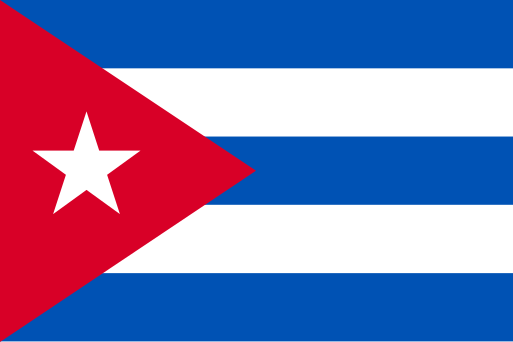 Cuba
Cuba