Legal framework on freedom of religion and actual application
The Constitution of Equatorial Guinea (adopted in 1991 and amended following a referendum in 2011) guarantees freedom of conscience, religion, and worship (Articles 13, 1, f, and 24, 4), and contemplates punishments for discrimination on the basis of tribe, ethnicity, gender, or religion, or coming from social, political or analogous motives (Article 15, 1).[1] Moreover, the constitution prohibits political parties from identifying themselves with a religion; instead, they must have a “national character and scope, thus shall not be based on tribe, ethnicity, region, district, municipality, province, gender, religion, social condition nor profession or occupation” (Article 9, 2). Individuals are free to change religions, and “Christians converting to Islam are permitted to add Muslim names to their Christian names on their official documents”.[2]
Article 24 (4) allows free choice concerning religious education. This means that “every person, private entity or religious community, legally constituted” has “the right to establish schools” on condition of “being subject to the official pedagogical plan” (Article 24, 3). In state schools, the study of religion is optional and may be replaced by a civil or social education course. Several religious groups, mainly Catholics and Protestants, operate both primary and secondary schools.[3]
A 1991 law, modified by a 1992 law,[4] sets out the rules for the registration of religious groups. It also officially sanctions preferential treatment for the Catholic Church and the Reformed Church of Equatorial Guinea, neither of which are required to obtain state registration.[5] This preferential treatment is demonstrated by the inclusion of the Catholic Mass in all official ceremonies, particularly during celebrations of the anniversary of the 1979 coup d’état, Independence Day, and the President’s birthday.
All other religious groups are required to register with the Ministry of Justice.[6] The evaluation of these requests is entrusted to the Ministry’s Director General. Some religious groups, including Muslims and Bahá’ís, need to register only once. Other, newer denominations may have to periodically renew their registration. Unregistered groups can be fined or banned. The registration process is extremely slow and, in some cases, can take years. However, this is due more to red tape than to an explicit political bias against particular religious groups.[7]
In October 2012, the government and the Holy See signed a concordat.[8] This guarantees the legal personality of the Catholic Church in the country. Moreover, it covers topics such as “canonical marriage, places of worship, educational institutions, and spiritual assistance to Catholic faithful in hospitals and prisons”.[9]
On 4 April 2015, the Ministry of Justice published a decree regarding religious activities. It stated that all religious activities taking place outside the hours of 6am to 9pm, and those held outside registered places of worship, can only go ahead with prior permission from the Ministry. The decree prohibits religious activities or preaching in private homes if these involve people who do not live there and requires foreign religious representatives or authorities to obtain permission in advance from the Ministry to lead or speak at religious activities.[10] Christian celebrations such as Christmas, Good Friday, Corpus Christi and the Immaculate Conception are national holidays.[11]
Incidents and developments
Equatorial Guinea is a tiny oil-producing country of 1.9 million people on the west coast of Central Africa, squeezed between Cameroon and Gabon, and includes the island of Bioko and four other smaller islands in the Gulf of Guinea.
The opposition leader, Julio Obama Mefuman, died in prison in January 2023 at the age of 51. He had been reportedly abducted in South Sudan and transported to the Equatoguinean capital of Malabo. He was a Spanish citizen, and just two weeks before his death Spain had opened an investigation targeting both Equatorial Guinea’s Minister of National Security and one of the President’s sons in connection with the kidnapping.[12] The European Parliament condemned the abduction and the death, calling for sanctions against the authorities involved and the repatriation of Mefuman’s body.[13]
In June, a military court sentenced Gabriel Nsé Obiang, leader of the opposition Citizens for Innovation (CFI) party, along with numerous party members, to lengthy prison terms ranging from nine to 29 years.[14] The use of a military tribunal was viewed as unusual by observers, and the trial was held “in camera” with defendants denied access to independent legal counsel.[15]
In September 2023, the Senate of Equatorial Guinea proposed amendments to Law No. 4/1991 on religious freedom to address issues with unregulated sects that engage in allegedly fraudulent forms of evangelisation, causing harm to society.[16] Key recommendations to update the law include conducting regular evaluations of religious organisations, enforcing stricter licensing requirements, and addressing exploitation and criminal activities within sects through inspections. The recommendations further proposed suspending unqualified leaders, creating a supervisory commission, and instituting mandatory inspections of places of worship, with penalties such as closures for non-compliance.[17]
Later in September 2023, the government shut down six Pentecostal and Evangelical churches for failing to comply with new registration regulations. This move was part of a broader effort, justified by the country’s Senate, to “protect the people” from what it described as the “bad practices of cults and religious confessions”.[18] Earlier, in May 2023, the Ministry of Justice had convened Evangelical and Pentecostal churches, instructing them to form a confederation similar to that of the Catholic and Presbyterian Churches. The Confederation of Churches was thus established on 11 May 2023, consisting of representatives from the majority of denominations and politicians, with the stated goal of addressing administrative needs.[19] The Ministry ordered all Churches that were not part of the confederation to cease their services, effectively revoking prior registrations that had allowed them to operate independently. Churches and pastors were given just nine days to comply by joining the confederation and registering their credentials. Pastors were required to present certificates in theology or religious studies from internationally recognised institutions, with equivalency certification issued by the National University of Equatorial Guinea.[20]
In a June 2024 interview with Agenzia Fides, Bishop Juan Domingo-Beka Esono Ayang of Mongomo, President of the Catholic Bishops’ Conference of Equatorial Guinea, spoke about new dynamics in the Church. He highlighted the significant increase in vocations to the priesthood, with the number of seminarians at the major seminary in Bata growing from around 40 to nearly 90 in just a few years.[21]
In July 2024, Rubén Maye Nsue Mangue, a pastor and former Justice Minister, was released after President Teodoro Obiang Nguema pardoned him. Mangue had been detained for two years following arrest in 2022 for calling the President a “demon” in a widely shared audio recording.[22] When he refused to apologise, he was charged with public disorder and banned from preaching. President Obiang, who has ruled since 1979 and won a sixth term in 2022 with nearly 95 percent of the vote, granted Mangue and 19 others amnesty with the expectation that they would behave as “repentant citizens”. Mangue stated that he had not been given a lawyer during his detention and had never been tried. He had served as Justice Minister from 1998 to 2004 before being dismissed by President Obiang.[23]
In November 2024, the Senate of Equatorial Guinea summoned the Minister of Justice to discuss growing concerns over the rapid increase in religious congregations and the misuse of religious freedom.[24] The session emphasised issues such as alleged corruption among pastors and religious leaders, manipulation of worship practices, and sectarian activities that allegedly presented pastors as divine figures with healing abilities. These activities were reported to contribute to social discord and unrest. The Senate aimed to understand the government’s approach in addressing these challenges, particularly through stronger regulatory measures.[25]
The Minister of Justice presented plans to ban practices considered “satanic”, disqualify their promoters, and carry out comprehensive inspections of Churches to identify and rectify irregularities.[26]
Prospects for freedom of religion
According to human rights organisations, Equatorial Guinea is plagued by poverty, corruption, and repression.[27] President Obiang Nguema has been in power since 1979, making him Africa’s longest-serving Head of State. Notwithstanding such broader human rights challenges, no significant violations of religious freedom were reported during the period under review. The situation remained stable, a trend that is likely to continue.

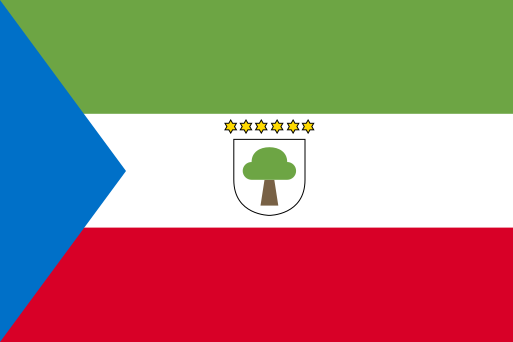 Equatorial Guinea