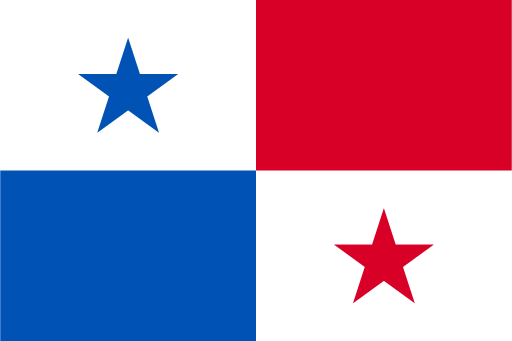
PANAMA
Legal framework on freedom of religion and actual application
The preamble to the constitution of Panama invokes God's protection.[1] According to Article 35, “All religions may be professed and all forms of worship practised freely, without any other limitation than respect for Christian morality and public order. It is recognised that the Catholic religion is practised by the majority of Panamanians.”
The constitution stipulates that “There shall be no public or private privileges, or discrimination, by reason of race, birth, social class, handicap, sex, religion or political ideology.” (Article 19)
The duties inherent to their mission notwithstanding, ministers of religion and members of religious orders “may hold public posts only when such positions are related to social welfare, public education, or scientific research”. (Article 45) It is illegal to establish political parties based on religion. (Article 139)
Before taking office, the president and vice-president take the oath of office with the words set out in Article 181: “I swear to God and to the Country to comply faithfully with the Constitution and the laws of the Republic.” However, Article 181 states that citizens who do not profess religious beliefs can dispense with the invocation of God in the oath.
According to Article 36, “Religious organisations have juridical capacity and manage and administer their property within the limits prescribed by law, the same as other juridical persons.”
According to Article 94, both state and private schools “are open to all students without distinction of race, social position, political ideology, [or] religion”.
Article 107 of the constitution stipulates that “the Catholic religion shall be taught in public schools”. However, “students shall not be obliged to attend religion classes, nor to participate in religious services” if their parents or guardians do not wish it.
Finally, the Code of Civil Procedure which was enacted in 2023 stipulates in article 755 that “buildings reserved for use by churches, for sacred things and other things that are for the exercise of religious worship” are considered assets that cannot be seized.[2]
Incidents and developments
In April 2023, at least five people, including three minors, were injured during a “ritual” held by a religious sect in the Ngäbe Buglé district, a distant indigenous region on Peterson Island, in the north of Panama.[3] The local authorities opened an investigation into the events.[4]
In July 2023, Panama adopted the definition of antisemitism proposed by the International Holocaust Remembrance Alliance (IHRA) during an event attended by government authorities, representatives from the Organisation of American States, the Ambassador of Israel and representatives of the Panamanian Jewish community.[5]
In August 2023, the Labour Ministry published a guide to identify discrimination in the workplace which recognises that religious beliefs and political ideas are among the main causes of discrimination.[6]
In August 2023, consecrated hosts were found spread on the floor of the Catholic Church of María Auxiliadora in Bejuca, spelling out a satanic phrase. It was not the first time that the church was desecrated, and parishioners were uncertain as to who could have carried out the sacrilege, given that the doors and windows of the building had not been forced.[7]
In August 2023, the Panamanian Interreligious Committee organised an “Afternoon of the Temples” to celebrate the 504th anniversary of the founding of Panama City. The event was open to the public, which was invited to visit 12 places of worship belonging to different religious communities, with the aim of promoting respect for religious freedom and showing the importance of religious heritage. The day ended with an interreligious prayer at the entrance of the Metropolitan Cathedral.[8]
In February 2024, the Committee met with members of the National Electoral Board, who explained the mission and goals of the organisation. The religious leaders expressed their wish to cooperate, and the committee named its Secretary General, Isis Navarro, as liaison officer.[9]
Religious communities often hold their festivals in the public space. An example is the celebration of Holy Week in the Old Town of the capital, which includes processions,[10] and the celebration of the Black Christ, attended by thousands of pilgrims in the Church of San Felipe de Portobelo.[11] Muslims freely celebrate Ramadan, which in 2023 largely coincided with the Christian season of Lent and Easter. In April 2023, members of the Muslim community told the press that different religions coexist peacefully and respectfully in Panama.[12]
The Catholic Church plays an active role in public debate. In February 2023, the Bishops’ Conference expressed its concern over several challenges which the country was facing: the increase in migration and the effects of mining and violent crime, which the bishops saw as having its roots in poverty and corruption.[13]
In 2023, according to Panama’s National Migration Service, a record number of 520,085 migrants heading north for the United States crossed the dangerous jungle region of the Darien Gap which straddles Panama and Colombia. The following year, another 302,203 crossed, mostly Venezuelans (68 percent), who were fleeing the chaos in their country.[14] In early 2025, Panama had to deal with a suddenly reversed flow of migrants, as thousands headed south following the sealing of the United States border by the Trump administration. In February of that same year, the United States deported directly to Panama 299 third-country nationals from countries such as China, Eritrea, Afghanistan and Russia.[15] By April, 180 of these had returned to their home countries under the “assisted voluntary return” programme of the International Organisation for Migration (IOM).[16]
In September 2023, the Bishops’ Conference of Panama criticised the approval of a contract between the government and a Panamanian company for the largest open-pit copper mine in Central America. The company is a subsidiary of the Canadian firm, First Quantum Minerals. Approval of the contract had been rushed through the National Assembly on a day when it did not normally convene. The bishops considered the procedure unconstitutional and asked the Supreme Court to intervene. Since the approval of the mine had led to large demonstrations, the bishops also defended the right to legal protests, without repression, violence or threats.[17] In November 2023, the Supreme Court accepted the argument of the bishops that the 20-year concession granted to the Canadian firm was unconstitutional, and President Laurentino Cortizo announced that the government would begin the process of shutting down the mine.[18]
In early 2024, the bishops published a document called “Dear Panama”, a pastoral reflection on ecology and taking care of “our Common Home”. In it, they explicitly opposed the extractive mining industry in the country and appealed to Panamanians to remain vigilant.[19] Besides praying for the new government,[20] the bishops highlighted the Church’s social function, especially in the pastoral accompaniment of prisoners, the sick and migrants.[21]
In April 2023, the Archdiocese of Panama expressed its concern over the expulsion of the Panamanian priest, Donaciano Alarcón Valdés, from Nicaragua. The Archbishop of Panama, José Domingo Ulloa, stated: “We reiterate what the Latin American Episcopate and Pope Francis himself have said about this regime, where all religious freedoms have been violated.” He added that the universal Catholic Church is united in prayer for the serious political and social crisis that the people of Nicaragua are enduring.[22]
Prospects for freedom of religion
The period between 2023-2024 saw the desecration of one Catholic Church, but there were no other reports of incidents of intolerance and/or religious discrimination. Of special note are the statements by members of the minority religious group, the Muslim community, to the effect that there is respect between different religions and that they have never experienced any problems in practising their faith. Prospects for religious freedom appear positive.
Sources


 Panama