Legal framework on freedom of religion and actual application
Since its creation in 2011, South Sudan has operated without a constitution and instead uses a transitional constitution.[1] Since independence from Sudan, the country has never held elections. The first were first scheduled to be held by 9 July 2015, which would have been followed by a constitutional process however, the elections have been repeatedly postponed.
In September 2024, South Sudan extended its transitional arrangement by two years through amendments to its transitional constitution. This is the fourth extension.[2] It had been hoped that elections would take place in line with the end of the transition period in December 2024 as outlined in the peace agreement. However, many people did not believe that the National Election Commission (NEC) had the operational or financial capability to run elections at the end of 2024.[3] In September 2024, the government announced that it was postponing the elections until December 2026. It said that it needed more time to do a census and allow for the registration of parties.[4]
While the extension of the transitional period is also aimed at providing the Unity Government with a chance to have a permanent constitution and making sure all stakeholders are satisfied with the outcome, there are fears that recent clashes between armed groups in Western Equatoria and Upper Nile State and the war in Sudan will adversely affect the fragile environment in the country.[5] The European Union expressed its regret at the decision of the transitional government to extend its transitional arrangement.[6]
The current transitional constitution, ratified on 9 July 2011 and subsequently amended in 2013 and 2015, enshrines in Article 8 the separation between religion and the State, guarantees that all religious groups are treated equally and declares that religion should not be used for divisive purposes.
Under Article 14, all persons are “equal before the law and are entitled to the equal protection of the law without discrimination as to race, ethnic origin, colour, sex, language, religious creed, political opinion, birth, locality or social status”.[7]
Article 23 details religious rights in the country, including the right to associate, form charitable organisations, acquire property, teach, fundraise, publish and observe days of rest.[8]
Generally, there is a high degree of openness in South Sudanese society towards religion. Christian and Muslim groups take part in common initiatives and religious communities can register with the Ministry of Human Affairs through the Relief and Rehabilitation Commission. However, the government does not strictly enforce registration, and many faith-based organisations operate without it.[9] During most public events there are both Christian and Muslim prayers, delivered in English and Arabic. Religious leaders have said that they are free to criticise government policy, notably during sermons when key government leaders are present.[10]
Several religious groups are represented in government institutions. President Salva Kiir Mayardit is a Catholic, while Sheikh Juma Saaed Ali, a high-level advisor on religious affairs, is a leader in the Islamic community.[11] However, as the security situation deteriorated in February 2025, the President sacked Vice President Hussein Abdelbagi, who is also a Muslim.[12]
Although not mandatory, religious education is included in state secondary schools and universities with students free to choose between courses on Christianity and Islam. Private religious schools are free to set their religious education programs.[13]
In September 2023, Parliament approved two laws seeking to provide justice to victims of abuses committed since civil war broke out in December 2013 as well as establishing a Commission for Truth, Reconciliation and Healing.[14]
In July 2024, the National Legislative Assembly amended the National Security Service (NSS) law. The amendments allow the agency to continue to arrest and detain people without a warrant. The amendment has caused friction between the government and opposition groups who were not part of the 2018 peace deal. In the past, the government has used trumped-up charges of “crimes against the State” to restrict the freedom of expression, assembly and association of opposition parties. The NSS is designed to be an intelligence gathering unit and is not tasked with arrests, yet during the first months after the passing of the amendment it detained activists, critics and even foreign citizens. In March 2024, the NSS arrested Kalisto Lado, the former head of Juba City Council, at his home after he had spoken out about irregular land acquisitions in the city. In April 2024, the security service brought Morris Awikjok Bak, a South Sudanese refugee and critic of the government, before a court in Juba to face charges. He had been forcibly disappeared on 4 February 2023 in Nairobi, Kenya, and was detained by the NSS who failed to disclose his location.[15]
Incidents and developments
The population of South Sudan is around 60 percent Christian, 33 percent animist and six percent Muslim, with smaller numbers of other religious groups. The country has received massive external help in rebuilding its Christian infrastructure since the war of independence, with one NGO alone – Samaritans Purse – rebuilding over 500 churches.[16]
The period since independence in 2011, has been marked by bitter rivalry and episodes of fighting between the largest tribe, the Dinka, led by President Salva Kiir, and the second-largest tribe, the Nuer, led by Vice President Riek Machar. President Kiir has invited increasingly large contingents of Ugandan troops into the country to bolster his forces, while Vice President Machar for a period formed an alliance with the Islamist regime in Khartoum.[17]
In December 2024, South Sudan was ranked as the most corrupt country in the world.[18] Senior members of the government and their business associates are alleged to enjoy levels of wealth beyond that of their equivalents in Western countries, whereas “at least 92 percent of South Sudan’s estimated 11 million people lived below the extreme poverty line”.[19]
In February 2023, Pope Francis made an ecumenical pilgrimage of peace to South Sudan. The Pope called the visit “the culmination of a journey that began some years ago, which has seen us meet in Rome in 2019, with the South Sudanese authorities to commit to overcome the conflict and build peace.” During his visit, the Pope talked about the critical role of women in “transforming the country”.[20] Pope Francis ended his South Sudan trip with a passionate plea for peace and forgiveness. At a Mass with over 100,000 faithful the Pope urged worshippers — including the president and his opponents — to abandon the “blind fury of violence” and called for an end to tribalism and corruption. His visit was conducted jointly with the then Archbishop of Canterbury and leader of the Anglican Communion, Dr Justin Welby, and Iain Greenshields, Moderator of the General Assembly of the Church of Scotland. This was the first time in Christian history that leaders of the Catholic, Anglican and Reformed traditions conducted a joint foreign trip.[21]
The three leaders hoped to raise awareness about the plight of the country which is oil-rich and yet is one of the poorest nations in the world. More than 2.2 million are internally displaced within South Sudan itself.[22]. All three leaders appealed for peace and sought to draw attention to the plight of women who suffer physical and sexual abuse and have suffered the burden of violent conflict for decades. The maternal mortality rate in South Sudan is the highest in the world.[23]
In March 2023, a controversial religious leader, Prophet Abraham Chol Maketh, the founder and head of the Cush International Church, was unexpectedly released from his detention after the National Security Service dropped all charges against him. He had been arrested in July 2021 on charges of inciting violence, disregarding COVID regulations and prophesying that the president and vice president would be removed from office by July 2021. In January 2023, Mr Maketh was sentenced to 31 months in prison after a court in Juba found him guilty of all charges. He had earlier denied Jesus Christ and told his followers to worship him instead.[24]
In April 2023, internal leadership disputes among senior bishops of the Episcopal Church of South Sudan (ECSS) led to the closure of a church in Langbaar B. Two years later, despite the shutdown, local youth defied the directive and forcibly reopened the church to hold Easter celebrations. Authorities responded by detaining four individuals and re-closing the church, citing the ongoing ecclesiastical conflict as the reason.[25]
In August 2023, St. Peter Church in Bor, Jonglei State, was forcibly shut down by armed youth affiliated with a competing Episcopal faction. In response, the Episcopal Archbishop of Juba urged the government to take action to safeguard religious leaders and places of worship.[26]
In the same month, mobile units of the SSPDF were accused of launching attacks on Christians in the Nyori and Mongo archdeaconries, involving looting and acts of torture. Episcopal bishops strongly denounced the assaults stating, “We the bishops, the clergies and the entire Christians of central Equatoria internal province, would like to express our deepest sadness on attacks, torture, looting of the Christians and arrest of the clergy of the Episcopal church of South Sudan by mobile force of Sudan People’s defense forces in Nyori and Mongo payams of Yei River County of Central Equatoria State”.[27] An SSPDF spokesperson stated they were unaware of the incident.
In late August, the National Salvation Front/Army (NAS) documented five separate incidents of attacks on clergy and traditional leaders. One case involved Rev. Seme Mawa, who was arrested and tortured, with church property looted by SSPDF forces. The NAS condemned these actions as part of a broader campaign of intimidation.[28]
Between December 2023 and February 2024, violence broke out in the oil-rich state of Abyei, which is claimed by both Sudan and South Sudan. Fighting flared up between the Ngok Dinka of Abyei State and the Twic Dinka of Warrap State on issues of local administration, revenue collection and the location of the border between Abyei and Warrap States. President Kiir comes from Warrap State and is a Dinka, which made it difficult for him to take decisive action to halt the fighting without appearing partisan. A presidential decree demanding disarmament was disregarded and the violence claimed hundreds of lives.[29]
On 27 April 2024, Fr Luke Yugue and his driver Michael Gbeko disappeared after leaving their Nagero Parish on a motorbike trip to another parish in the Western Equatorial State. The bishop of the region said that the kidnapping was likely due to ethnic tensions between the Azande and Balanda groups in Tombura County. In 2021, clashes between these two groups resulted in thousands being killed and displaced.[30] A year on, there was still no news of the missing men, and in the meantime funeral prayers were said for them.[31]
Also in April 2024, the Sudan and South Sudanese Catholic Bishops Conference (SSSCBC) expressed its full support for a decision of the Vatican Dicastery for Evangelisation to suspend Fr John Mathiang Machol for allegedly orchestrating the attempted murder of the bishop-elect of the Catholic Diocese of Rumbek, the Italian-born Christian Carlassare.[32] Police retrieved calls of Fr Machol from a mobile phone which one of the assailants lost during the attack.[33] The statement of the bishops stood in sharp contrast to a March 2024 ruling of the Supreme Court which quashed all charges against the priest, who was subsequently released from prison. Undeterred by the court decision, the Archbishop of Juba, Cardinal Stephen Mulla, said that the Church condemned in the strongest terms “this heinous act of violence against a shepherd of the Church” and added that Fr Machol would neither receive nor give sacraments until further notice.[34]
In April 2024, a Seventh-day Adventist pastor, Daniel Garang Yel, was released after being held captive in Warrap State by men who he said might belong to “a satanic group”. Pastor Daniel was kidnapped while on his way to conduct baptisms. His kidnappers alleged he was from a rival ethnic community and said that they did not want to “advance the Adventist Church” in Gogrial East County of Warrap State.[35]
In July 2024, Pope Francis transferred Bishop Christian Carlassare from Rumbek to the newly created Diocese of Bentiu.[36]
In November 2024, renewed ethnic violence in Warrap State resulted in over 50 fatalities, with reports indicating that religious buildings were destroyed and a church elder was among those killed. In the aftermath, faith-based organizations stepped in to mediate the conflict and advocate for peace.[37]
In January 2025, 16 Sudanese refugees were killed and many more injured when a group of young people armed with machetes attacked them. The violence was ignited by videos of the Sudanese armed forces killing civilians in Wad Madani in southern Sudan. The Sudanese army killed at least 29 South Sudanese civilians, including children, in the process of recapturing the city from the Rapid Support Forces. The Catholic Archbishop of Juba, Stephen Ameyu Martin Mulla, urged calm and restraint, asking people to work “towards healing and rebuilding, fostering an environment where every individual can feel safe”.[38]
In February 2025, President Kiir appointed Benjamin Bol Mel, a business associate and a fellow Dinka, as vice president, apparently identifying him as chosen successor. The United States had previously placed Benjamin Mel under sanctions for alleged corruption.[39]
Prospects for freedom of religion
During the period under review, South Sudan has seen conflict in Abyei State as well as spillover of animosity from the war in Sudan. Refugees from Sudan have flooded the country, placing great pressure on the already limited resources. International confidence has been sapped by the government’s decision to extend the transitional period and delay elections, even although the announced purpose was to create an environment in which inclusive and credible elections could take place and allow key stakeholders to draft a permanent constitution that reflected the will of the people. Tensions between President Salva Kiir and his rival, the former Vice President Riek Machar, have recently re-erupted and there are fears that the relative calm experienced for the past few years will quickly dissipate.
The prospects for religious freedom in South Sudan remain negative.

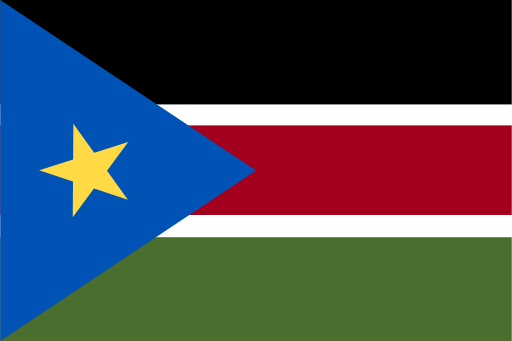 South Sudan