Legal framework on freedom of religion and actual application
The constitution[1] of the Democratic Socialist Republic of Sri Lanka, revised in 1972 and 1978 with amendments through to 2015, provides for religious freedom and enshrines no preferential treatment based on religion. According to Article 10, “Every person is entitled to freedom of thought, conscience and religion, including the freedom to have or to adopt a religion or belief of his choice.” Article 12 (2) states: “No citizen shall be discriminated against on the grounds of race, religion, language, caste, sex, political opinion, place of birth or any one of such grounds”, while Article 14 (1,e) states that every citizen is entitled to “freedom, either by himself or in association with others, and either in public or in private, to manifest his religion or belief in worship, observance, practice and teaching”.[2] Article 15 states that the law may restrict the fundamental rights provided in Article 14 (1) in the interests of racial and religious harmony or in relation to parliamentary privilege, contempt of court, defamation or incitement to an offence, or national economy.[3]
The 1972 constitutional amendments conferred a privileged status upon Buddhism. While Article 10 continues to guarantee freedom of thought, conscience and religion, Article 9 establishes that “the Republic of Sri Lanka shall give to Buddhism the foremost place and accordingly it shall be the duty of the State to protect and foster the Buddha Sasana” (i.e., Buddhist teachings, practices, and doctrine). This provision underscores a constitutional asymmetry that, despite formal guarantees of religious freedom, grants Buddhism a preeminent role in the country’s legal and cultural framework.[4]
Sri Lanka is one of approximately 80 countries wherein the Penal Code includes a blasphemy law. Article 291A states: “Whoever, with the deliberate intention of wounding the religious feelings of any person, utters any word or makes any sound in the hearing of that person, or makes any gesture in the sight of that person, or places any object in the sight of that person, shall be punished with imprisonment of either description for a term which may extend to one year, or with fine, or with both.”[5]
Article 291B states: “Whoever, with the deliberate and malicious intention of outraging the religious feelings of any class of persons, by words, either spoken or written, or by visible representations, insults or attempts to insult the religion or the religious beliefs of that class, shall be punished with imprisonment of either description for a term which may extend to two years, or with fine, or with both.”[6]
Sri Lanka’s International Covenant on Civil and Political Rights (ICCPR) Act has increasingly come under scrutiny for operating, in practice, as a de facto blasphemy law. Originally enacted in 2007 to implement Article 20 (2) of the International Covenant on Civil and Political Rights (ICCPR) and to counter incitement to religious, national, or racial hatred, the law, particularly Section 3, is widely regarded as overly broad and imprecise. This vagueness has enabled warrantless arrests and non-bailable detention, creating a legal environment conducive to the arbitrary detention of individuals accused of offending religious sentiments, especially those of the Buddhist majority.[7]
Observers and analysts have highlighted the law’s selective enforcement, which appears to disproportionately shield Buddhism from criticism rather than address genuine instances of incitement. A prominent example is the 2023 arrest of YouTuber Sepal Amarasinghe, who was detained for allegedly making disrespectful remarks concerning the Sacred Tooth Relic in Kandy.[8]
Other laws affecting freedom of expression and religious freedom include the 1979 Prevention of Terrorism Act (PTA), in which “a person, by words, either spoken or intended to be read or by signs or by visible representations or otherwise causes or intends to cause the commission of acts of violence or religious, racial or communal disharmony or feeling of ill-will or hostility between different communities or racial or religious groups shall be guilty of an offence”.[9] According to the NGO End Blasphemy Laws, the act “has been criticized for being used to target minorities, critics of the government, journalists and political opponents”.[10]
In May 2023, the government prepared an unofficial version of the draft bill to amend the Muslim Marriage and Divorce Act (MMDA). If passed, women would be allowed to hold positions as marriage registrars. 17 Muslim Members of Parliament rejected the proposal. However, prominent members of the Muslim community criticised the Muslim MPs for their conservative stance, pointing out the failure of the existing law to address the problem of child marriage and the harmful effects of polygamy. According to them, the MMDA entrenched existing divisions within the Muslim community.[11]
In January 2024, the Sri Lankan Parliament passed the Online Safety Act. Critics voiced deep concerns, fearing it could be used as a weapon to undermine freedom of expression and stifle dissent. Of particular concern is that the bill provides sweeping powers to the Online Safety Commission to decide on whether content can be regarded as a “prohibited statement”, to make recommendations to internet providers to remove such content and to disable access for those deemed offenders.[12]
On 12 December 2024, the National Secretariat for Non-Governmental Organisations issued a formal directive requiring all NGOs, both domestic and international, including those previously registered under the Companies Act No. 07 of 2007, to register under the Voluntary Social Service Organizations (VSSO) Act No. 31 of 1980. The regulation mandates either re-registration or initial registration, the submission of extensive documentation, and seeking clearance from multiple governmental bodies, including the Ministries of Defence, Foreign Affairs, and the relevant line ministries, prior to the issuance of a six-month provisional certificate. Organisations with religious aims are equally subject to these requirements. While the government has framed this policy as a measure to enhance financial transparency and institutional accountability, domestic civil society actors have expressed concern and the International Center for Not-for-Profit Law (ICNL) commented that it was difficult to view this “as anything other than an attempt to expand surveillance and control”.[13]
In both 2024 and 2025, the U.S. Commission on International Religious Freedom (USCIRF) recommended that the U.S. Department of State include Sri Lanka on its Special Watch List, citing the country’s “severe violations of religious freedom.”[14]
Incidents and developments
Notwithstanding the legal framework in Article 14 defending religious freedom, the constitutional declaration of supremacy of Buddhism over other faiths, within a deeply religious culture, has become a source of increasing tension and division. Sri Lanka, having witnessed rising ethno-religious nationalism and the failure of successive governments to address a genuine and growing disaffection among religious and ethnic minorities, now risks being plunged into a prolonged period of religious repression and conflict.
The reporting period witnessed significant political and economic developments. The year 2022 saw the declaration of a state of emergency, mass protests at Colombo’s Galle Face Green, mass emigration of young people, inflation running at 50 percent, and public transport and ambulances ceasing to run because the country had run out of money to buy fuel.[15] At the same time, an ideologically driven ban on fertiliser decimated Sri Lanka’s crops.[16] Following the country’s default on foreign debt in May 2022, President Gotabaya Rajapaksa resigned on 13 July 2022 after fleeing to Singapore via the Maldives. In the aftermath, the then Prime Minister, Ranil Wickremesinghe, assumed the role of acting president, [17] initiating his tenure with a crackdown on demonstrators.[18]
Subsequently, in September 2024, presidential elections resulted in the victory of Anura Kumara Dissanayake, leader of the Marxist-Leninist Janatha Vimukthi Peramuna (JVP). The JVP secured 42 percent of the popular vote. On 14 November 2024, the National People’s Power (NPP) coalition, which backed Dissanayake, won a decisive parliamentary majority, claiming 159 seats out of 225.[19]
Buddhist nationalist organisations in Sri Lanka have grown in number, influence, and radicalism. These groups often depict non-Buddhist communities as foreign elements, framing Sri Lanka as a land consecrated by the Buddha exclusively for the protection and advancement of Buddhism. Among the most prominent are Bodu Bala Sena (Buddhist Power Force, BBS), Ravana Balaya, Sinhala Ravaya, and the Sinhale Jathika Balamuluwa. BBS, led by Venerable Galagoda Aththe Gnanasara Thero, has been particularly active, with its inflammatory rhetoric linked to attacks on minority-owned religious sites and businesses. The group frequently uses social media to propagate anti-Muslim messaging. The rise of such groups poses a threat to national cohesion and risks fuelling retaliatory extremism among Muslim and Hindu communities.[20]
Complicating, and in some cases fuelling, this rise in radicalisation is an escalation in land disputes, notably in the Northern and Eastern Provinces, where Buddhist heritage conservation efforts increasingly clash with the territorial claims of religious minorities, primarily Tamil Hindus and Muslims. The Department of Archaeology, operating under the Ministry of Buddhasasana, Religious, and Cultural Affairs, is mandated to safeguard cultural heritage but has frequently been implicated in these conflicts. These disputes reflect broader post-conflict challenges related to unresolved land rights, identity, and access, which continue to engender mistrust and fears of displacement among minority populations. The involvement of Buddhist clergy, government authorities, and military forces in certain land appropriations has intensified concerns, with allegations that heritage preservation is instrumentalised to justify encroachments on lands traditionally held by minority groups. Such practices raise critical questions regarding transparency and legality, while exacerbating ethno-religious tensions.[21]
With the growing imposition of a hard-line Sinhalese Buddhist presence in the Eastern Province of the country, there is a disturbing counter growth of militant Tamil Hinduism. Siva Senai (meaning “Army of Shiva”) is a Hindu nationalist political organization in Sri Lanka, founded in October 2016. The group’s proclaimed interest is to protect the interests of Sri Lankan Tamil Hindus, particularly in the Northern and Eastern provinces of the country.[22] The potential for Siva Senai to grow in militancy and capability is especially high because it enjoys the support of surging Hindu-nationalist groups, such as the Rashtriya Swayamsevak Sangh (RSS), in nearby India.
Having said this, the Eastern regions, which are densely populated with Muslims, have also witnessed a growing relationship between Hindu and Buddhist organisations. Groups such as the “Hindu Buddhist Association” illustrate this collaboration. In 2023, India donated around $15 million towards the construction and renovation of Buddhist monasteries around the country.[23] In August 2023, the governor of the Eastern Province, Senthil Thondaman, stopped the construction of a Buddhist temple in Trincomalee. In response, a group of Buddhist monks threatened to “squeeze the neck” of the governor.[24]
The rise of Hindu nationalism in India has increasingly extended its influence into northern and eastern Sri Lanka, particularly through social media platforms, exacerbating the digital and ideological divide between the Tamil-speaking regions and the Sinhalese majority in the South. Most hate speech recorded, however, originated from the predominantly Buddhist Sinhalese. Between November 2022 and October 2023, the National Christian Evangelical Alliance of Sri Lanka (NCEASL) found that 85 percent of online harmful speech was posted in the Sinhala language and 11 percent was in Tamil. Most of the hate speech was posted on Facebook and in the form of visual media, including videos and memes. 69 percent of hate speech was directed towards Christians, with Muslims being targeted frequently.[25]
In 2023, however, Hindu extremist narratives gained some prominence online, notably amid the Israel-Palestine conflict, which saw a marked intensification of anti-Christian sentiment. Manifestations of this hostility included scepticism toward a reported Catholic miracle in Point Pedro involving the reported shedding of blood from the eyes of a statue of the Virgin Mary, and opposition to the construction of a church near a Hindu temple. Additionally, accusations against the Liberation Tigers of Tamil Eelam (LTTE) reemerged, alleging that the group promoted Christianity at the expense of Hinduism.[26] Tamil Christians were further accused of perpetrating “cultural genocide” through religious conversions, rhetoric that was sometimes equated with acts of terrorism.[27]
In 2024, the Sri Lankan army restricted access to Hindu temples in a high-security area. Only seven out of 21 temples in the area could be used, and worshippers had to use army transport and provide personal details, including their home address, to use the temples.[28]
In March 2024, eight Tamil Hindu worshippers attending a festival were arrested, detained for more than 10 days, and allegedly abused. Although the local authorities had ruled that the festivities for the Shivarathi to celebrate the god Shiva could proceed, police arrived at the temple and assaulted worshippers. Authorities claimed that people were arrested because the small Hindu ritual fires posed a hazard. Buddhist monks accompanied the police who arrested and allegedly abused the Hindu worshippers.[29]
Militant Hindu Tamil groups are particularly active in Batticaloa, where they have organised numerous attacks against Christians. In June 2024, when members of a Catholic church in Batticaloa tried to erect a statue of the Virgin Mary near a Hindu temple, they faced opposition and Hindu extremists placed Hindu and Buddhist idols near the statue to provoke the community, though they were later removed.[30]
Growing discrimination against minorities by the State as well as non-State actors, especially against Muslims, coupled with widespread animus toward Muslims generally since the end of the civil war, have contributed to growing tensions.
In October 2023, hundreds of Tamil and Muslim livestock farmers who have been grazing their cattle in the Ampara district for generations clashed with Sinhalese farmers, many of whom are former soldiers. To consolidate the use of the land by Sinhalese farmers, Buddhist monks installed a new statue of Buddha in the district near the disputed area.[31]
In April 2024, the Sri Lankan customs department detained 15,000 copies of the Qur‘an for distribution among deserving Muslims in the country. In September, the consignment was released and given to the Department of Muslim Cultural Affairs.[32]
Christians in Sri Lanka, particularly those of independent Evangelical churches, are concerned about the ongoing registration issue. Churches that want to establish new sites are required to register, but the government may use their existing venues. Critics of the country’s system of Church registration state that this violates the Christian community’s religious freedom because it will require approvals from government authorities and a review of religious beliefs.[33] Furthermore, in March 2024, the Religious and Cultural Affairs Minister, Vidura Wickramanayaka, ordered the Commissioner General of Buddhist Affairs to instruct the police to conduct raids on unregistered religious centres if they are engaged in “religious conversion”.[34]
The National Christian Evangelical Alliance of Sri Lanka (NCEASL) reported 43 cases involving intimidation, threats, interference in worship services, and obstruction of Christian congregations in 2023.[35]
One such example was experienced by Members of the Way to the Comfort Ministry Church in Seethwaka, Sri Lanka, who have faced ongoing pressure to cease Christian activities in their village. On 26 January 2025, Buddhist monks confronted the Church leadership, demanding an end to worship services and asserting that only Buddhist practices were permitted in the area. The pastor was also accused of conducting forced conversions and receiving foreign funding. The following evening, an unidentified individual threw stones at the church, damaging the roof and narrowly missing the pastor’s wife. The congregation filed a police report, prompting an official investigation. Authorities subsequently organised a meeting involving three monks, the pastor and his wife, Church members, and local clergy to seek a peaceful resolution. Although the monks appeared to accept this outcome, one later informed the pastor of their intention to initiate legal action.[36]
In relation to the 2019 Easter Sunday bombings, which targeted three churches and several hotels across Sri Lanka, the Supreme Court ruled on 12 January 2023 that former President Maithripala Sirisena, along with four senior officials, had failed to act on prior intelligence warnings. There had been a breakdown of communications in the government which meant that neither the prime minister nor the cabinet knew about the security warnings,[37] and the president, who was out of the country when the bombs exploded, said he had not been informed about them.[38] Nevertheless, the Court ordered Sirisena to pay approximately 100 million rupees in compensation, with an additional 210 million rupees imposed collectively on the other implicated officials.[39]
In April 2024, on the eve of the fifth anniversary of the Easter Sunday attacks, the U.N.’s top envoy, Marc-Andre Franche, urged the government to carry out a “thorough and transparent investigation” to uncover those responsible for the Easter attacks in 2019.[40] Oblate Fr Rohan Silva, Director of the Centre of Society and Religion in Colombo, said that the Archbishop of Colombo, Cardinal Malcolm Ranjith, had “saved bloodshed” by meeting Muslim leaders after the explosions and assuring them that “nothing would happen to their community”.[41]
In September 2024, newly elected President Anura Kumara Dissanayake pledged to reopen investigations into the attacks, assuring Cardinal Malcolm Ranjith of his determination to uncover the full truth during a call made shortly after his inauguration.[42]
This renewed commitment followed a UK Channel 4 television investigation that alleged potential complicity or facilitation by Sri Lankan intelligence agents, allegedly intended to create a political environment conducive to the rise of Gotabaya Rajapaksa. In response, the government established a commission of inquiry, chaired by a retired judge, to investigate these claims.[43]
In January 2025, Cardinal Ranjith further called on the government to carry out constitutional reforms. He urged a comprehensive inquiry not only into the motives and failures behind the Easter Sunday attacks but also into broader issues of corruption that, in his view, continue to undermine Sri Lanka’s democratic governance.[44]
In October 2024, the UN Human Rights Council (UNHRC) adopted a resolution to extend the mandate of the UN Office of the High Commissioner for Human Rights (OHCHR) by one more year to monitor “human rights concerns” in the country. The Janatha Vimukthi Peramuna (JVP) government opposed this resolution. Foreign Minister, Vijitha Herath, said that their party’s election manifesto had “progressive human rights protection mechanisms,” and the government needed “more time to carry out the tasks of monitoring violations”. Critics fear that the ruling JVP and National People’s Power (NPP) parties are unwilling to support the resolution because they have strong ties to the security forces and that members of the NPP might have individuals associated with war crimes and other human rights abuses.[45]
As detailed in the section on the legal framework, Sri Lanka’s application of the International Covenant on Civil and Political Rights (ICCPR) Act has increasingly focused on speech perceived as offensive to Buddhism, the country’s majority religion. Between May 2023 and December 2024, several high-profile arrests were made under this legislation. Among the most notable were those of comedian Nathasha Edirisooriya and Pastor Jerome Fernando.
In May 2023, comedian Nathasha Edirisooriya was arrested for delivering a satirical performance referencing Buddhism. Although charged under the ICCPR Act, she was later released on bail, with the High Court noting that her remarks had not incited violence and that her comic routine had not led to hostility towards Buddhists.[46]
On 1 December 2023, an Evangelical Christian pastor, Jerome Fernando, was arrested by the Criminal Investigation Department (CID) for his remarks that the Buddha had been “looking for Jesus”. Pastor Fernand was arrested for violation of hate speech laws. The pastor was remanded in custody until 13 December.[47]
This trend has drawn significant criticism from civil society organisations and international observers, who argue that not only is the ICCPR Act being misapplied (to suppress dissenting or non-conformist religious expression, thereby undermining freedom of speech and religious discourse), but also selectively applied where police and the judiciary have been quick to use anti-hatred legislation against minority communities but not against Buddhists.
One such example took place in October 2023, when Sumanarathana Ampitiye, an extremist Sinhala Buddhist monk with a history of hate speech, assault and incitement of violence, posted a social media clip threatening to kill all the Tamils in the south. “Every single Tamil person will be cut into pieces! They will all be killed! All the Tamils in the south will be cut into pieces and butchered! The Sinhalese will massacre them.”[48]
An exception to this trend came on 10 January 2025 when Galagodaaththe Gnanasara Thero, a prominent Sinhalese Buddhist monk, leader of the Sinhalese Buddhist nationalist organisation BBS and close ally of former President Gotabaya Rajapaksa (Gnanasara Thero served on a presidential task force aimed at protecting religious harmony during Rajapaksa’s administration), was sentenced to imprisonment for insulting Islam and inciting religious hatred. The conviction relates to statements he made during a 2016 media conference in which he declared: “Islam is a cancer... it must be eradicated”. This case represents a rare conviction of a Buddhist monk in Sri Lanka and marks Gnanasara Thero’s second prison sentence, previously incarcerated in 2024 for hate speech targeting Muslims but granted bail while appealing his four-year sentence. With the nine months’ imprisonment and a fine of 1,500 Sri Lankan rupees, (with a one-month extension of imprisonment if unpaid) the Colombo Magistrate’s Court underscored the constitutional protection of religious freedom.[49] This 2025 ruling intensifies scrutiny on religious intolerance and the influence of Buddhist nationalism within Sri Lanka’s political and social spheres.[50]
Prospects for freedom of religion
Despite a significant decline in terrorist activity — Sri Lanka has recorded five consecutive years without attacks and has a score of zero on the 2025 Global Terrorism Index — this positive security development contrasts starkly with ongoing deterioration in religious freedom. The continued application of vague and discriminatory laws to detain religious minorities, suppress dissent, and, at times, shield perpetrators of ethno-religious violence, undermines fundamental rights. Figures such as the extremist Buddhist monk Sumanarathana Ampitiye, continue to persist in promulgating inflammatory rhetoric with minimal repercussions, perpetuating a climate of impunity.
Additionally, the increasing assertion of Sinhalese Buddhist influence in the Eastern Province has exacerbated tensions with Tamil and Muslim communities, intensifying fears of increased vitriol and violence. The resulting emergence of an extremist form of Tamil Hinduism is particularly alarming because it could portend the revival of the kind of violent Tamil militancy that fuelled the separatism of the Tamil Tigers but in a religious and sectarian form. Radical groups like Siva Senai could become the minority counterparts of majoritarian groups, such as Bodu Bala Sena (BBS), with each feeding off the other in a downward spiral of sectarian rivalry.
Finally, the newly elected Janatha Vimukthi Peramuna (JVP) government’s rejection of the UN Human Rights Council resolution and its reluctance to pursue accountability for civil war abuses further diminish public trust in state institutions. Due to the variety of political, social, and religious tensions across the country, the prospects for freedom of religion in Sri Lanka remain negative.


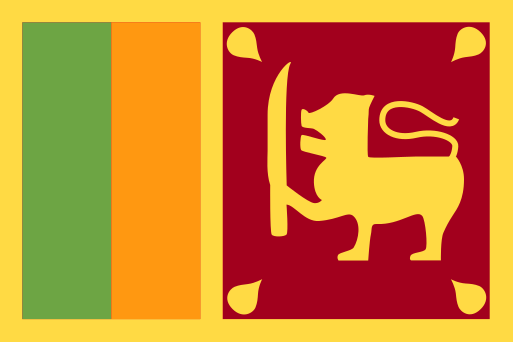 Sri Lanka